
Empty Land Lots for Sale: How to Identify and Unlock Hidden Potential


Did you know that while national land inventory has plummeted by over 23% since 2019, prices for raw land have surged by a staggering 86.5%? It’s a competitive market, and finding quality empty land lots for sale often feels like searching for a needle in a haystack. You’ve likely felt the sting of seeing a “perfect” lot only to realize it’s landlocked, lacks utility access, or carries a price tag that makes your head spin.
It’s completely normal to worry about buying a money pit or feel sidelined by traditional banks that often demand 20% down payments. You deserve a path to ownership that doesn’t require an exclusive club membership or a mountain of cash. We’re going to show you how to evaluate raw land like a pro, avoid the common traps that sink most beginners, and unlock high-value deals before they ever hit the mainstream sites.
We’ll walk you through spotting zoning potential and using creative strategies like seller financing to bypass the stress of traditional lending. By the end of this guide, you’ll have the insider tools to move from a curious browser to a confident land owner who knows exactly where the hidden value lies.
Key Takeaways
Learn the crucial differences between raw land and infill lots to ensure your property is actually buildable and matches your goals.
Spot high-potential empty land lots for sale by following the “path of progress” and evaluating physical traits like topography and drainage.
Find out why the most profitable bargains are found off-market and how to source them before they ever reach public listing sites.
Protect your investment with a 5-point due diligence process that covers legal ownership, deeded access, and zoning restrictions.
Use specialized deal-finding tools to automate your research and get a curated list of high-value opportunities delivered directly to you.
Table of Contents
What are Empty Land Lots for Sale? Understanding the Categories
When you search for empty land lots for sale, it’s easy to assume that “vacant” simply means a blank slate ready for your vision. That isn’t always the case. In the 2026 market, where national land inventory has contracted by 23.6% since 2019, understanding what you’re actually looking at is the difference between a high-yield investment and a costly mistake. Raw land prices have surged by 86.5% over that same period, making the stakes higher than ever. You need to know if a lot is truly “ready to build” or if it’s just a patch of dirt with hidden hurdles.
Why are so many sellers listing these lots instead of developing them? Often, it’s a matter of liquidity. Many owners inherited property or bought it years ago as a hands-off investment. As land values hit record highs, these sellers are looking to cash out without the headache of permitting or construction. This creates an opening for you. By stepping in where the current owner sees a tax burden, you can unlock the hidden potential they’ve overlooked.
Raw Land vs. Improved Lots
Raw land is the ultimate “insider” play. It has no utilities, no cleared building sites, and often no paved access. It carries the highest risk because you’re responsible for everything. However, because it’s the least developed, it offers the highest reward for patient investors. You’re buying at the lowest possible price point before any value is added.
Improved lots sit at the opposite end of the spectrum. These properties usually have water, sewer, and electricity already at the curb. They command a premium because the heavy lifting of infrastructure is done. If you want a faster path to building, this is your target. Somewhere in the middle are infill lots. Think of these as the “missing teeth” in an established neighborhood. They are often surrounded by existing homes, making them highly desirable for builders who want to skip the uncertainty of rural development.
Zoning Basics for Empty Lots
Your success depends on Understanding Land Use Categories before you sign a contract. Zoning laws dictate exactly what can happen on a property. A beautiful five-acre lot might be zoned strictly for agricultural use, meaning you can’t build a modern triplex there without a fight. Always check the “Highest and Best Use” of a lot. This is a professional evaluation of which use provides the most value while being legally and physically possible.
A zoning variance is a specific legal exception to current land-use regulations that allows you to use your property in a way not typically permitted by the standard code. Knowing how to secure one can turn a restricted, low-value lot into a goldmine. Whether you’re looking at residential, agricultural, or commercial empty land lots for sale, the zoning map is your most important tool for identifying profit potential.
How to Identify the Profit Potential in Raw Land
Finding equity in a deal is what separates a savvy investor from a casual browser. When you look at empty land lots for sale, don’t just see the current price. See the future value. The “Path of Progress” is your most reliable friend in this business. Look for where new schools are being built or where major highways are expanding. If the city is growing north, buy north. It’s that simple. By positioning yourself in the direction of growth, you let the local economy do the heavy lifting of appreciation for you.
But you must look closer at the dirt itself. A “cheap” lot is often cheap for a specific reason. Topography and drainage are the primary culprits. If the land sits at the bottom of a basin, you aren’t buying a homesite; you’re buying an unbuildable swamp. Poor drainage can cost tens of thousands to fix. In some cases, it makes the land legally undevelopable. Always walk the property after a heavy rain to see where the water goes.
Utilities are another hidden profit killer. Is the nearest power pole 50 feet away or half a mile? Bringing in water, sewer, and electricity can cost more than the land itself. Always calculate the “real” cost of development before you pull the trigger. Perhaps most importantly, never buy a lot without confirmed, deeded access. Landlocked properties are a legal nightmare that can tie up your capital for years. If you want to skip the guesswork and find vetted opportunities, checking a curated vacant land list can help you find properties where these hurdles are already identified.
Environmental and Physical Constraints
Soil testing is your “make or break” moment for rural lots. A percolation or “perc” test determines if the ground can handle a septic system. No perc, no house. It’s that direct. You should also use FEMA maps to check for flood zones and wetlands. Even if the land looks dry in July, the maps tell the truth about what happens in March. Vegetation is another factor to consider. While thick timber might look like a clearing expense, in some regions, it’s a harvestable asset that can actually offset your purchase price.
The Legal Landscape: Easements and CC&Rs
Don’t let easements shrink your building footprint. An easement gives someone else the right to use a portion of your land, such as a utility company or a neighbor. This can severely limit where you can actually place a structure. Covenants, Conditions, and Restrictions (CC&Rs) are common in developed areas. They can limit everything from your house size to whether you can park an RV on the property. Finally, always get title insurance. It protects you from previous owners’ debts or legal claims that could strip you of your ownership. It’s a small price for total peace of mind.
On-Market vs. Off-Market: Where the Real Land Bargains Hide
Most people start their search for empty land lots for sale on sites like Zillow or Redfin. It’s a logical first step, but it’s often a dead end for finding a true bargain. By the time a lot hits the Multiple Listing Service (MLS), it has already been screened by local developers and professional flippers. You’re essentially looking at the leftovers that the pros decided weren’t worth the effort. The real equity is found in off-market deals. These are properties sold directly by owners who haven’t listed them publicly, allowing you to negotiate without a crowd of competitors driving up the price.
Off-market sourcing isn’t just about the price tag; it’s about the terms. One of the biggest perks of going this route is the opportunity for seller financing. Traditional banks are notoriously difficult with land loans, often requiring a 20% down payment and charging higher interest rates than a standard mortgage. In early June 2026, with average 30-year fixed mortgage rates in the mid-6% range, land loans are even more expensive. Seller financing lets you bypass the bank. You deal directly with the owner to set the down payment and monthly terms. It’s a secret weapon for building a portfolio without needing a massive cash reserve or a perfect credit score.
Why Sellers Choose Off-Market
Speed and privacy are the main drivers for sellers who avoid the traditional brokerage route. Some owners inherited a property they never visited and simply want a quick, quiet exit. Others are dealing with tax-defaulted properties. They owe back taxes to the county and need to sell before the land is seized. This creates a massive opportunity for you to step in and provide a solution. To find these owners, some investors use “skip tracing” to find contact information, but that requires a lot of time and technical know-how.
The Power of Land Subscriptions
Sifting through thousands of bad listings to find one diamond is exhausting. You could spend hundreds of hours combing through county records and sending out mailers. Curation is the smarter way to play the game. Instead of doing the heavy lifting yourself, you can use a subscription service to access “pocket listings” that never see the light of day on public sites. These services act as a filter, removing the unbuildable swamps and landlocked traps we discussed earlier.
Vacant Land List provides weekly curated deals that match these criteria perfectly. You get a steady flow of high-value plots and seller-financed offers delivered directly to your inbox. This “insider” advantage allows you to act with confidence, knowing the research has already been started for you. It’s about working smarter, not harder, to secure your piece of the map.
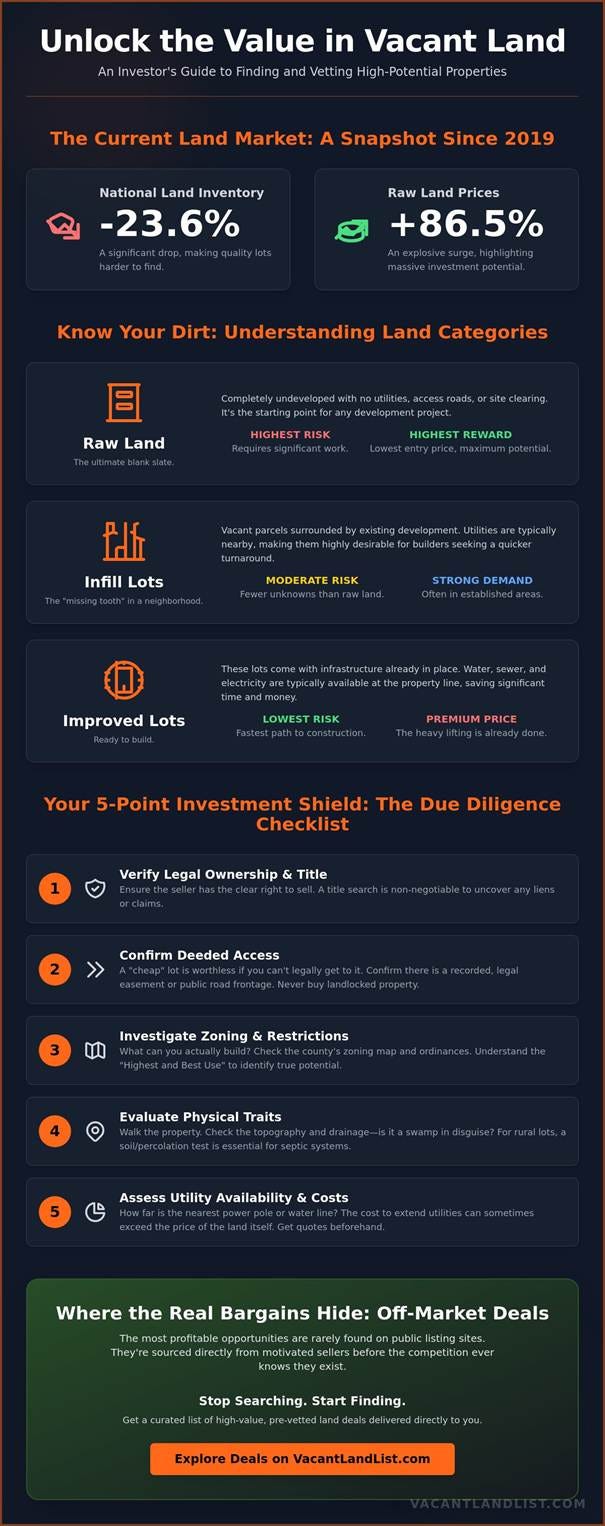
The 5-Point Due Diligence Checklist for Empty Lots
Buying land isn’t just about the dirt; it’s about the paperwork. If you don’t do your homework, those empty land lots for sale that look like bargains can quickly turn into expensive liabilities. You need a systematic approach to uncover what the seller might not even know themselves. This checklist is your shield against the “money pit” scenario.
Step 1: Verify Ownership. Never take a seller’s word at face value. Scams exist where individuals attempt to sell property they don’t actually own. Cross-reference the seller’s identification with the name on the most recent deed recorded at the county assessor’s office.
Step 2: Check Physical Access. A lot isn’t worth much if you can’t get to it. Ensure there’s a legal, deeded road leading to the property. Don’t assume a visible dirt track is a public road; it could be a private driveway where you have no legal right to pass.
Step 3: Review Zoning and Restrictions. Don’t rely on the listing description. Call the county planning department directly. Ask about setbacks, minimum square footage for builds, and if they’ve recently passed any zoning reforms that could impact your plans.
Step 4: Assess Utilities. Contact local providers for quotes on well drilling, septic installation, and grid connection. If the nearest transformer is half a mile away, the cost to bring power to the site could exceed the purchase price of the land.
Step 5: Inspect the Title. A title search is non-negotiable. It reveals hidden liens, unpaid property taxes from previous owners, or legal encumbrances that could restrict how you use the land.
To simplify this process and see properties that have already passed through an initial layer of screening, you can subscribe to a curated vacant land list and save yourself dozens of hours of manual research.
Tools for Virtual Due Diligence
You can do a significant amount of research from your desk using GIS (Geographic Information Systems) maps. Most counties provide these portals for free, allowing you to see property line maps, flood zones, and topography. Google Earth Pro is another powerful tool. It lets you tilt the view to analyze the terrain’s slope and see how neighboring properties are being used. This helps you identify high-potential empty land lots for sale without spending a fortune on gas for site visits.
When to Hire a Professional
While technology is great, sometimes you need a pro on the ground. A licensed surveyor is essential if you’re planning to build near a boundary or if the “visual markers” like old fences don’t match the legal description. If you’re looking at land near old industrial sites, an environmental consultant can check for soil contamination. Finally, if the local regulations seem like a maze of jargon, a land-specialist attorney can help you navigate the fine print and ensure a clean closing.
Finding Your Next Deal with the Vacant Land List
Finding your way through the noise of public listings is often the hardest part of land investing. You shouldn’t have to spend your weekends digging through dusty county records or cold-calling property owners who have no interest in selling. That’s where we step in. The Vacant Land List handles the heavy lifting of research, filtering out the unbuildable traps and focusing only on high-potential opportunities. We’ve built a community of over 8,000 active subscribers who are all focused on building wealth through affordable land. By joining us, you’re tapping into a collective knowledge base that values transparency and simplicity.
The Weekly Deal Advantage
Imagine a curated flow of off-market opportunities delivered directly to your inbox every single week. These aren’t the picked-over remains found on the MLS. They are fresh, hand-selected empty land lots for sale from across the United States. We prioritize seller-financed properties because we believe land ownership should be accessible to everyone, not just the wealthy. This means you can often bypass invasive credit checks, skip the rigid bank hurdles, and secure a property with terms that actually fit your monthly budget. The Deal-Finding Tool helps users locate budget-friendly plots by filtering through thousands of data points to find the real gems.
Our research covers the essentials you need to make an informed decision. We look for properties with clear access and documented boundaries, ensuring you don’t inherit a legal headache. This methodical approach guides you through the process with a steady, reassuring pace. You get to see the “insider” deals before the mainstream market even knows they exist. It’s like having a knowledgeable scout doing the legwork while you make the final call.
Start Your Land Investment Journey Today
Waiting for the “perfect” deal to appear on a mainstream site is a losing strategy. In a market where land prices per acre have grown by 76.6% nationally since 2019, time is your most valuable asset. The barrier to entry is much lower than many people realize. We frequently feature deals with as little as $75 down, making it possible for almost anyone to start their journey toward long-term equity growth. This is about making land ownership an attainable goal rather than an exclusive club.
Don’t let the complexity of traditional real estate keep you on the sidelines. We’ve simplified the path so you can move forward with confidence. Whether you’re looking for a future homesite, a recreational escape, or a long-term investment, the best time to start is before the next price surge. Join the Vacant Land List today and get your first batch of off-market deals.
Take Control of Your Land Investment Future
You now have the framework to evaluate raw land and the tools to spot hidden potential. By prioritizing off-market opportunities and following a strict due diligence checklist, you can avoid the common pitfalls that stall most new investors. Finding high-quality empty land lots for sale doesn’t have to be a full-time job when you have the right insider access and expert guidance.
Success in this market comes down to acting on vetted information before the competition catches up. Gerald Harris and our community of 8,000+ active subscribers are already identifying these opportunities every week. Whether you’re looking for long-term equity or a place to build your dream home, we make it simple to start with deals beginning as low as $75 down.
Don’t let the complexity of traditional financing or the high prices on public sites hold you back. Your path to property ownership is clearer than ever. Get Weekly Off-Market Land Deals Sent to Your Inbox and start building your portfolio today. You’ve got the knowledge; now it’s time to take the first step toward your piece of the map.
Frequently Asked Questions
Is it hard to get a loan for an empty land lot?
Yes, securing a traditional bank loan for raw land is generally more difficult than getting a standard mortgage. Most lenders require a minimum down payment of 20% for improved lots, and even higher for raw acreage. In early June 2026, with mortgage rates in the mid-6% range, land loans are even more expensive. Because there’s no structure as collateral, banks view these as higher-risk, which is why many buyers prefer seller financing.
Can I live in an RV on my vacant land lot?
It depends entirely on the local zoning ordinances and county regulations. While some rural areas permit temporary RV living during construction, many municipalities prohibit it as a permanent residence. You must check the specific zoning code for your property to see if there are time limits or permit requirements. Don’t assume that owning the dirt gives you the automatic right to camp or live there indefinitely in a vehicle.
What is the “perc test” and why is it important for land?
A perc test measures how quickly water drains through the soil to determine if the ground can support a septic system. If you’re looking at empty land lots for sale in rural areas without city sewer, this test is the most critical part of your due diligence. Without a passing result, you likely won’t be granted a building permit for a home. It’s a make or break factor for future development and property value.
How do I find out who owns a specific empty lot?
You can identify the owner by visiting the county assessor’s website or using their online GIS mapping portal. Most counties provide a searchable database where you can enter a parcel number or address to see the current deed holder’s name and mailing address. If the online records are outdated, a trip to the local recorder’s office or hiring a title company for a preliminary report will provide the most accurate ownership data.
What are the hidden costs of buying vacant land?
Beyond the purchase price, you should budget for closing costs which typically range from 2% to 5% of the total price. Hidden expenses often include land surveys, title insurance, and the high cost of bringing utilities like power and water to the site. You also need to account for annual property taxes and potential clearing costs. These extras can add up quickly, so always get quotes before finalizing your offer.
How much does it typically cost to clear an empty lot for building?
Clearing costs vary significantly based on the density of vegetation and the terrain. A flat lot with light brush is much cheaper to prep than a heavily wooded or sloped property requiring major grading. While light clearing might be a few thousand dollars, removing large trees and stumps can be a major expense. It’s best to have a local contractor walk the site and provide a specific estimate based on your building plans.
What is seller financing in land deals and how does it work?
Seller financing is an arrangement where the property owner acts as the bank. Instead of getting a traditional loan, you pay a down payment directly to the seller and make monthly installments until the balance is paid. This is a popular way to buy empty land lots for sale because it often bypasses strict credit checks and bank hurdles. It’s a simple, flexible tool that makes land ownership accessible to more people.
Is buying land without seeing it in person a good idea?
Buying land sight-unseen carries risk, but it’s increasingly common thanks to modern research tools. You can use GIS maps, Google Earth Pro, and FEMA flood data to analyze the property from your computer. However, it’s always wise to have a “boots on the ground” contact, like a local surveyor or a trusted friend, to verify the physical access and current condition. Virtual research is powerful, but it can’t replace a physical inspection.