One Acre of Land for Sale: The Ultimate Guide to Finding and Buying Your First Acre
What if you could stop scrolling through overpriced listings and actually secure your own private sanctuary for less than the cost of a used car? While the median price for one acre of land for sale on major sites hit $62,365 in early 2026, the real deals are hiding where most people aren’t looking. You don’t need a massive bank account or a real estate license to find them. You just need to know how to spot the “Goldilocks” plot that everyone else is missing.
It’s frustrating to feel priced out by a 23.6 percent drop in land inventory since 2019 or to feel paralyzed by confusing zoning laws and the fear of buying a “useless” piece of dirt. You want a place to build, grow, or simply escape, but the process often feels like an exclusive club you weren’t invited to join.
This guide will change that by showing you exactly how to visualize an acre’s potential and perform due diligence like a pro. We’ll reveal the secrets to finding off-market deals and understanding low down payment options so you can buy with total confidence. From checking property taxes to securing seller financing, you’re about to get the roadmap to your first acre.
Key Takeaways
Learn why 43,560 square feet is the “Goldilocks” size for balancing self-sufficiency with low property taxes and easy maintenance.
Discover how to bypass the high prices of public listing sites by finding one acre of land for sale through off-market sources.
Master a 5-point due diligence checklist to verify legal access and utility feasibility so you never buy a “useless” plot.
Explore accessible ownership paths like seller financing that allow you to secure property without traditional bank loans or high credit scores.
Visualize the true scale of an acre by understanding how a standard home footprint and a self-sufficient garden fit onto the land.
Table of Contents
Why One Acre of Land is the Perfect Entry Point for Investors in 2026
Visualizing Your Plot: What Can You Actually Do with One Acre?
The Hidden Market: Finding 1-Acre Lots for Sale Outside of Zillow
Why One Acre of Land is the Perfect Entry Point for Investors in 2026
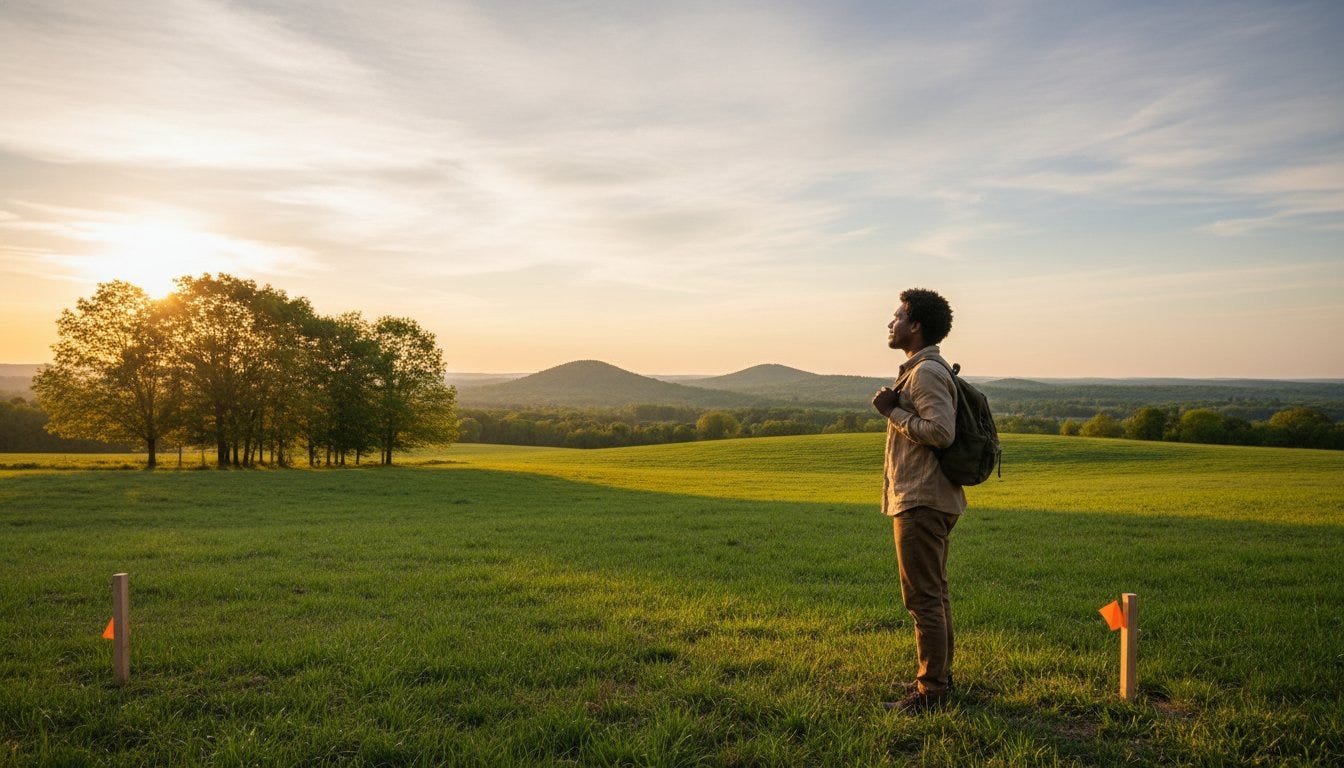
Imagine standing on 43,560 square feet of your own soil. That’s the magic number. When you look for one acre of land for sale, you aren’t just buying dirt; you’re securing a specific scale of opportunity. It’s the “Goldilocks” size of real estate. An urban lot often feels cramped and restrictive, while a 40-acre ranch can feel like a full-time job. One acre is different. It’s large enough to offer genuine privacy and space for self-sufficiency, yet small enough that you can maintain it with a simple riding mower on a Saturday morning.
Owning land changes how you think. For a long-term renter, the idea of “property” is something you pay for but never control. Stepping onto your first acre shifts that perspective. It’s a manageable entry point that feels attainable rather than overwhelming. You aren’t just a tenant; you’re a stakeholder in the earth. This scale allows you to learn the ropes of land ownership, zoning, and basic maintenance without the high-stakes pressure or massive overhead of a giant estate.
The Investment Case for the Single Acre
Investors love this size because it hits the sweet spot of resale liquidity. If you need to sell your asset later, there’s a much larger pool of buyers looking for a single acre than for a massive tract of wilderness. Finding one acre of land for sale at a discount is often easier because these smaller parcels are frequently overlooked by large-scale developers. Carrying costs stay remarkably low too. You’ll find that property taxes on raw land are often a fraction of what you’d pay for a developed lot with a structure. Because land is a finite resource, holding a one-acre plot acts as a tangible hedge against inflation that doesn’t require the constant maintenance or repair costs of a rental building.
One Acre vs. The World: A Size Comparison
How do you wrap your head around the size? Visualizing Your Plot: What Can You Actually Do with One Acre? starts with a simple comparison; it’s roughly 90 percent of a standard American football field. If you’ve ever stood on the sidelines, you know that’s a significant amount of territory. In a typical crowded suburb, developers often squeeze four to six houses into a single acre. When you own the whole thing yourself, that space translates to massive potential for gardens, outbuildings, or just peace and quiet. Lenders often view this as the transition point where a “residential lot” becomes “acreage.” This distinction is vital because it can change your options for rural land loans and how local authorities view your property’s potential use.
Visualizing Your Plot: What Can You Actually Do with One Acre?
When you finally spot a one acre of land for sale that fits your budget, your mind likely jumps to the possibilities. Can you build a house, plant a massive garden, and still have room for a workshop? The short answer is yes, but the layout requires a bit of strategy. A standard 2,000 square foot ranch-style home only occupies about 4.6 percent of your acre. This leaves over 41,000 square feet for everything else. However, you must account for the “usable” portion of the dirt. If your plot has steep slopes, protected wetlands, or massive rock outcroppings, your actual building envelope might be smaller than the property lines suggest. Always verify the topography before you commit.
Zoning is your next hurdle. A residential zoning tag usually means you’re cleared for a home, but agricultural zoning might be required if you want a full-scale farm. Finding a one acre of land for sale with unrestricted zoning is often the holy grail for creative builders. It offers the most freedom for unique projects. Before you start dreaming of a home business or a secondary dwelling, you should check for any local CC&Rs. These private agreements can sometimes be stricter than county laws, dictating everything from the color of your roof to where you park your trailer.
The 1-Acre Homestead Layout
Mapping your acre is like a game of Tetris. You’ll need to designate a zone for your home site and another for your septic field, which typically requires a specific distance from any water source or well. If self-sufficiency is the goal, one acre can produce a surprising amount of food. You can easily fit a large vegetable garden, a small orchard, and a coop for chickens. Most counties use an “animal unit” rule to determine livestock limits. While you might not have room for a herd of cattle, a few goats or a dozen hens are usually well within the limits for a single acre. Adding a perimeter of fast-growing evergreens can create a natural privacy buffer that makes your plot feel like a hidden forest.
Recreational and Commercial Potential
If you aren’t ready to build a permanent residence, an acre offers excellent recreational utility. It’s a perfect size for a high-end glamping setup or a gravel pad for your RV. Many landowners use their space for specialized storage, building a climate-controlled workshop for car restoration or boat maintenance. If you’re looking for properties with this kind of flexibility, you can browse curated land opportunities that meet your specific needs. Just remember to verify utility access early. Bringing power and water to a raw acre can range from a few thousand dollars to a significant investment depending on how far the nearest lines are located.
The Hidden Market: Finding 1-Acre Lots for Sale Outside of Zillow
Most buyers start their search on major real estate portals. It’s a natural first step, but it often leads straight into the “Zillow Trap.” On these sites, you’re only seeing retail inventory. These properties are listed by brokers who bake a 6 percent to 10 percent commission into the asking price. By the time a one acre of land for sale hits a national aggregator, you’re competing with thousands of other buyers. This high demand drives prices toward that Q1 2026 median of $62,365 per acre. To find a true bargain, you have to look where the crowd isn’t.
The real opportunity lies in off-market deals. These are properties owned by “tired” landowners who may have inherited the dirt or moved away years ago. They aren’t actively trying to sell, but they’d happily offload the tax burden for a fair cash offer. Investors find these gems through skip tracing and direct mail. By reaching out directly, you bypass the middleman. Sellers love this because they keep more of the sale price, and you love it because you aren’t fighting a bidding war. It’s a simpler, quieter way to do business.
Where the Real Deals Live
Finding these hidden plots requires a few “insider” tools. You don’t need a massive budget; you just need to know where the data is kept. Some of the best sources include:
County Tax Delinquent Lists: Every county keeps a record of owners who are behind on property taxes. These are the most motivated sellers you’ll ever find.
Social Media Groups: Search for “Land for Sale” groups specific to your target county. Many owners post here to avoid listing fees.
Specialized Newsletters: Savvy scouts often use a Vacant Land List Subscription to get curated, off-market opportunities sent straight to their inbox.
Evaluating Price Without an Appraisal
How do you know if a deal is actually a deal? You look at “Comps,” or comparable sales. Find at least three similar one-acre plots that sold in the last six months within a five-mile radius. Don’t fall for the “price per acre” myth. Smaller lots always cost more per square foot than 100-acre tracts because they’re easier to sell and develop. If you see a one acre of land for sale priced at 50 percent below the local average, proceed with caution. Low prices often signal “red flags” like a lack of legal road access or significant title issues that could cost thousands to fix later. A bargain is only a bargain if the land is actually usable.
Critical Due Diligence for 1-Acre Lots: A 5-Point Checklist
Finding a promising one acre of land for sale is only half the battle. Before you sign any contracts, you must perform due diligence to ensure your “perfect” plot isn’t a financial sinkhole. Raw land carries risks that don’t exist with traditional homes. You aren’t just buying dirt; you’re buying the legal right to use it. If you skip these steps, you could end up with a beautiful piece of property that you aren’t legally allowed to build on or even visit.
Step 1: Legal Access. Never assume a dirt path equals a legal entrance. If the property doesn’t have direct frontage on a public road, you need a recorded easement. Without it, the land is landlocked, and you’re at the mercy of your neighbors.
Step 2: Utilities. The cost of bringing power to a remote acre can be staggering. Check the distance to the nearest transformer. If you’re going off-grid, solar is an option, but you’ll still need a plan for water and waste.
Step 3: Perk Testing. This is the most vital test for any rural lot. A percolation test determines if the soil can absorb liquid. If the land fails a “perk test,” you cannot install a standard septic system, which often makes the land unbuildable for residential use.
Step 4: Title Search. You don’t want to inherit someone else’s debt. A title search uncovers hidden liens or back taxes. With the U.S. median property tax bill sitting between $2,900 and $3,200 as of March 2026, unpaid balances can add up quickly.
Step 5: Surveying. Don’t rely on old fences or “handshake” boundaries. A professional survey marks the exact corners of your 43,560 square feet. It’s the only way to know exactly where your kingdom begins and ends.
To avoid these common pitfalls and find properties that have already been vetted for quality, you can sign up for a Vacant Land List to browse curated deals with transparent details.
The “Invisible” Obstacles to Building
Some restrictions don’t show up on a physical walk-through. Easements are “invisible” rights that allow others to use your land, such as utility companies or neighbors needing a driveway. You also need to watch out for setback requirements. These local laws dictate how far from the property line you must build. On a narrow one-acre lot, a 50-foot setback on all sides can significantly shrink your actual building area. Finally, verify if you’re buying the mineral rights. In some states, someone else could own the right to extract resources from beneath your garden.
Remote Research Tools for 2026
You can do a massive amount of research from your laptop. Start with Google Earth to check the terrain and look for hidden swampy areas. Most counties now offer GIS (Geographic Information System) maps that show property lines, zoning, and even elevation contours. Don’t be afraid to pick up the phone and call the County Planning Department. Ask them directly about any building moratoriums or specific restrictions for the area. It’s also vital to verify flood zones via FEMA maps to ensure your future home doesn’t require astronomical insurance premiums or face high-risk water damage.
How to Secure Off-Market 1-Acre Deals with Seller Financing
You don’t need a massive bank account or a perfect credit score to start your journey as a landowner. Seller financing is the ultimate “insider” secret for securing a one acre of land for sale without the headache of traditional bank approvals. In this arrangement, the person selling the land acts as the lender. You make a down payment directly to them and then pay off the balance in monthly installments. It’s a private, flexible agreement that opens doors for people who might be turned away by a standard mortgage company.
The barrier to entry is often lower than you’d imagine. While banks typically demand 20 percent or more for raw land, you can find off-market deals with as little as $75 down. Sellers are often motivated to offer these terms because it turns an unproductive piece of dirt into a consistent stream of passive income. Instead of paying annual property taxes on a vacant lot, they receive monthly checks plus interest. It’s a win-win situation that bypasses the middleman and keeps the process simple.
Negotiating Your Terms
When you find a one acre of land for sale with financing, everything is negotiable. You can focus on lowering the down payment if you’re cash-strapped, or you can aim for a lower total purchase price if you have more capital upfront. As of June 2026, bank land loans are available with interest rates around 5.000 percent; expect private seller rates to be slightly higher in exchange for the convenience and lack of a credit check. You might also structure a “balloon payment.” This allows you to make small, affordable payments for three to five years before a final lump sum is due, giving you time to save or prepare the land for building.
Your Shortcut to 1-Acre Opportunities
Understanding the paperwork is vital for your protection. You’ll generally see a Land Contract or a Deed of Trust. In a Land Contract, the seller keeps the legal title in their name until the final payment is made. With a Deed of Trust, the title transfers to you immediately, but the seller holds a lien against the property as security. Both are common, but you should always know which one you’re signing.
If you’re ready to stop searching and start owning, you need a way to find these deals before they get snatched up. Join 8,000+ investors getting off-market land deals every week to see curated, pre-vetted 1-acre gems. Using a specialized list saves you hours of research and connects you with sellers who are already prepared to offer the flexible financing terms you need to secure your first acre.
Claim Your Piece of the Earth Today
Owning land isn’t a dream reserved for the wealthy; it’s a practical goal you can achieve by focusing on the “Goldilocks” scale of a single acre. You’ve learned how to visualize your 43,560 square feet, how to navigate the 5-point due diligence checklist, and why off-market deals offer the best value. Finding the right one acre of land for sale doesn’t have to mean fighting bidding wars on retail sites or navigating complex bank loans. By using seller financing and looking where others aren’t, you can secure your legacy with a surprisingly low entry cost.
The heavy lifting of research is already done for you. Over 8,000 active subscribers already use our curated weekly updates to find properties that never hit the open market. If you’re ready to stop dreaming and start building, you can get off-market 1-acre land deals delivered to your inbox for $75 down. Your future sanctuary is out there, and it’s more accessible than you ever thought possible. Take that first step today and watch your vision for self-sufficiency finally take root.
Frequently Asked Questions
Is one acre of land enough to be self-sufficient?
Yes, you can produce a significant portion of a family’s food on a single acre with intensive planning. While you won’t have room for a large herd of cattle, you can easily manage a large vegetable garden, a small orchard, and small livestock like chickens or goats. It’s about maximizing the efficiency of your 43,560 square feet through methods like vertical gardening or aquaponics.
How much does one acre of land typically cost in the US?
Prices vary wildly based on location and land type. National averages for undeveloped rural land range from $1,500 to $2,500 per acre, while farm real estate averages closer to $4,000. If you’re browsing commercial sites, the median price for one acre of land for sale reached $62,365 in the first quarter of 2026. You’ll find the lowest prices in the West and the highest in the Northeast.
Can I build a house on one acre with a septic tank and well?
Usually, a single acre provides enough space for both a well and a septic system. You’ll need to follow local health department regulations that dictate the minimum distance between your water source and waste system. The most important factor is the percolation test. If the soil can’t absorb liquid properly, you won’t be able to install a standard septic tank regardless of the lot size.
What is the difference between a land lot and an acre?
An acre is a precise mathematical unit of area, whereas a “lot” is a general term for a parcel of land. A lot can be any size, from a tiny 0.10-acre urban plot to a 50-acre mountain tract. When you see one acre of land for sale, you know exactly how much surface area you’re getting. A lot’s size is only determined by its specific property boundaries on a plat map.
How do I find out who owns a one-acre property that is sitting empty?
The most direct way is to check the county tax assessor’s records. Most counties offer an online GIS map where you can click on any parcel to see the owner’s name and their billing address. If the info isn’t online, a quick trip to the county clerk’s office will allow you to search the most recent deed. This is a primary strategy for finding off-market deals before they’re listed publicly.
What are the hidden costs of buying one acre of raw land?
Expect to pay between 3 percent and 5 percent of the purchase price in closing costs, including title insurance and recording fees. You’ll also need to budget for a professional survey and potential “impact fees” from the county for future building. Don’t forget annual property taxes. The U.S. median property tax bill sits between $2,900 and $3,200 as of March 2026.
Does seller financing require a credit check for land purchases?
Often, it doesn’t. Because seller financing is a private agreement between you and the landowner, the terms are flexible. Many sellers care more about your down payment and your ability to make monthly installments than your traditional credit score. It’s a fantastic way to secure property if you don’t fit the rigid lending criteria of a standard bank or credit union.
How do I know if my one-acre lot is landlocked?
You must review the property’s legal description and title report to verify legal access. Just because there’s a physical road or driveway doesn’t mean you have the legal right to use it. Look for a recorded easement that grants you the right to cross neighboring property to reach a public road. If no easement exists and the land doesn’t touch a public street, it’s considered landlocked.